
A renewable energy transition is the structural shift of an electricity or energy system away from fossil fuels toward renewable sources like solar, wind, hydroelectric, and geothermal power, fundamentally changing how energy is generated, distributed, and consumed.
This transformation isn’t just about swapping coal plants for solar farms. It represents a complete redesign of energy infrastructure, market structures, workforce training, and community planning. The stakes are clear: energy systems account for roughly three-quarters of global greenhouse gas emissions, making this transition the single most powerful lever for climate action. Yet beyond environmental imperatives, these transitions unlock economic opportunities, improve public health through cleaner air, and strengthen energy security by reducing dependence on imported fuels.
Right now, we’re witnessing renewable energy transitions unfold at dramatically different speeds across the globe. Some regions have already crossed the 50% renewable electricity threshold, while others are just beginning to install their first large-scale wind or solar projects. Understanding what drives successful transitions, and what slows them down, matters for anyone working in sustainability, shaping policy, educating communities, or simply trying to make informed choices about energy at home or work.
This article breaks down how renewable energy transitions actually work in practice. You’ll learn the core mechanics that enable grid transformation, the different pathways communities and nations take, where these systems are already powering real economies today, and the practical obstacles that still need solving. Whether you’re advocating for cleaner energy in your community, advising on sustainability strategy, or teaching the next generation about climate solutions, you’ll walk away with a grounded understanding of what energy transformation entails and what makes it succeed.
What Renewable Energy Transitions Mean
A renewable energy transition is the deliberate, large-scale transformation of how a society produces, distributes, and uses energy, moving away from coal, oil, and natural gas toward solar, wind, hydro, and other renewable sources. This shift represents far more than swapping out one type of power plant for another. It’s a fundamental restructuring of the entire energy ecosystem, touching every component from generation infrastructure to grid architecture, regulatory frameworks, and even daily consumption habits.
At its core, this transition addresses the urgent need for GHG reductions while building resilient energy systems capable of meeting growing demand sustainably. The process demands coordinated changes across technology, economics, policy, and social behaviour, all working in tandem rather than in isolation.
Understanding key terminology helps clarify what these transitions actually involve:
- Energy System Transformation
- The comprehensive overhaul of generation, transmission, distribution, and consumption infrastructure, not merely adding renewable capacity to existing fossil fuel systems.
- Decarbonization
- Reducing carbon dioxide emissions across the energy sector by replacing fossil fuels with zero-emission renewable sources and improving energy efficiency.
- Energy Mix
- The combination of different energy sources a region uses, with transitions aiming to shift the balance heavily toward renewables while phasing out non-renewable sources.
- Baseload Power
- Continuous electricity supply meeting minimum demand at all times, traditionally provided by coal or nuclear but increasingly met through renewable combinations with storage.
- Grid Modernization
- Upgrading transmission and distribution networks to handle variable renewable generation, enable two-way power flow, and integrate smart technologies for real-time balancing.
- Distributed Generation
- Producing electricity at or near the point of consumption through rooftop solar, local wind, or community systems rather than relying solely on large centralized plants.
The scope of these transitions extends beyond environmental benefits. They reshape energy security, economic structures, employment patterns, and community resilience. A complete transition requires rethinking how we generate peak power during high demand, store excess renewable energy when production outpaces consumption, manage grid stability with variable wind and solar output, and ensure equitable access throughout the transformation process.
How Renewable Energy Transitions Work
The Technical Transformation
The physical infrastructure shift begins with retiring fossil fuel power plants, decommissioning coal-fired stations and natural gas facilities that have supplied baseload power for decades. This isn’t simply turning off switches; it involves planning replacement capacity years in advance to prevent blackouts and ensuring workers transition to new roles.
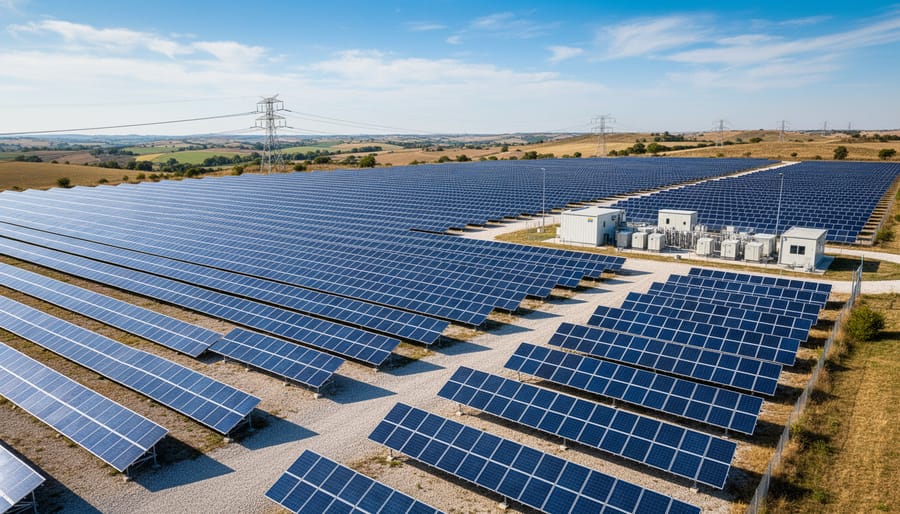
Simultaneously, renewable generation assets scale up rapidly. Utility-scale solar farms and offshore wind installations provide bulk power, while distributed rooftop solar systems democratize energy production. These installations require careful capacity planning, calculating how much generation capacity replaces retiring fossil plants while accounting for growth in electricity demand as transportation and heating electrify.
Grid infrastructure must transform fundamentally. Transmission lines designed for centralized fossil fuel plants can’t efficiently handle distributed renewable sources generating power across wider geographic areas. Engineers upgrade substations, install smart grid technology for real-time monitoring, and build new transmission corridors connecting renewable-rich regions to population centers.
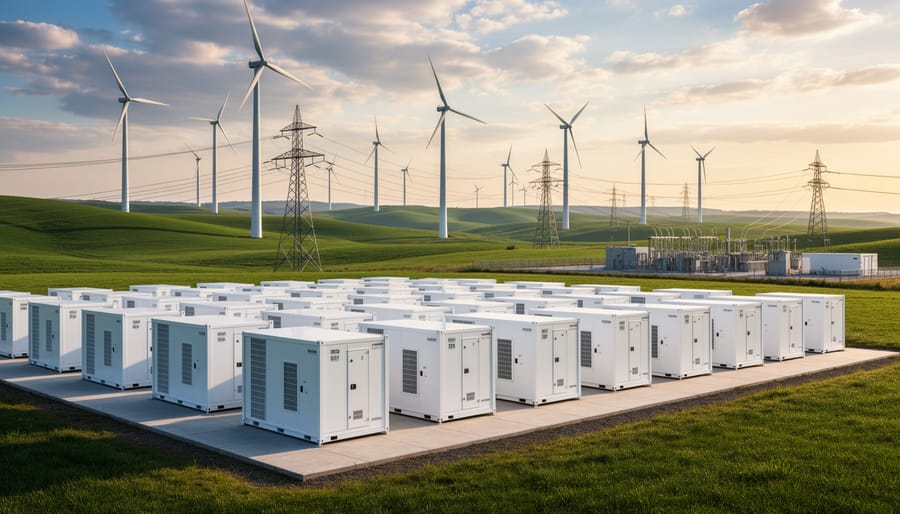
Battery storage systems solve intermittency challenges inherent in solar and wind generation. Large-scale battery installations store excess renewable energy during peak production hours, then discharge when demand exceeds generation. Homeowners and businesses learning to properly size solar batteries can maximize their energy independence while supporting grid stability. Grid operators balance supply and demand second-by-second, coordinating these storage resources with flexible generation sources and demand response programs to maintain the consistent frequency and voltage modern society requires.
Economic and Market Shifts
The economic argument for renewables has fundamentally shifted over the past decade. Solar and wind power now consistently undercut fossil fuels on price in most markets, with renewable costs dropping 80-90% since 2010. This cost advantage transforms the transition from an environmental aspiration into sound financial planning.
Financial mechanisms accelerating this shift include carbon pricing systems that make polluters pay for emissions, redirecting billions in fossil fuel subsidies toward clean energy deployment, and the explosive growth of green bonds and climate-focused investment funds. Institutional investors increasingly view renewable projects as lower-risk assets with predictable returns, while fossil fuel holdings face mounting stranded asset concerns.
Carbon markets create additional revenue streams for renewable projects through tradable emissions credits, further tilting investment decisions toward clean energy. Banks and development institutions now offer preferential financing rates for renewable infrastructure, recognizing both the climate imperative and the business case.
The economic logic is clear: building new renewable capacity costs less than operating existing coal plants in many regions. As storage technology costs decline alongside generation costs, the financial case for transition strengthens daily, making renewables the default choice for new energy investment globally.
Policy and Regulatory Frameworks
Government policy shapes the pace and direction of renewable energy transitions. National and regional governments establish renewable energy targets, measurable goals like “50% renewable electricity by 2030”, that signal clear expectations to investors, utilities, and communities. These targets drive planning decisions and capital allocation toward clean energy infrastructure.
Phase-out timelines create certainty by setting firm dates for retiring coal plants or ending fossil fuel subsidies. When Germany legislated its coal exit by 2038, it allowed affected regions years to prepare economic alternatives and workforce transitions. Clear deadlines prevent indefinite delays.
Financial incentives accelerate adoption. Feed-in tariffs guarantee fixed prices for renewable electricity, production tax credits reduce project costs, and renewable energy certificates create tradable value for clean generation. Conversely, eliminating fossil fuel subsidies levels the economic playing field.
Permitting reform addresses bureaucratic barriers. Streamlined approval processes for wind farms and solar installations reduce development timelines from years to months. Grid connection policies determine whether renewable projects can actually deliver power to users.
International climate commitments, like Paris Agreement pledges, create accountability frameworks and enable technology transfer between nations. Countries share best practices, financing mechanisms, and technical expertise.
Policies work best when coordinated across levels: national targets, regional planning, and local zoning rules must align. Inconsistent regulations create confusion and slow progress, while integrated frameworks provide the stable conditions renewable transitions require.
Types of Renewable Energy Transition Pathways
Centralized Grid Transitions
Large-scale renewable energy projects feeding into existing transmission infrastructure represent the most common pathway in countries with established electrical grids. Utility-scale solar farms spanning hundreds of acres and offshore wind installations with capacities exceeding 1,000 megawatts plug directly into high-voltage transmission networks, replacing retiring coal and natural gas plants. This approach leverages existing grid architecture while upgrading substations, transformers, and control systems to handle variable renewable generation.
Denmark demonstrates this pathway effectively, offshore wind farms now supply over half the nation’s electricity through integrated transmission planning. Similarly, Spain’s massive solar buildout connects remote generation sites to population centers via enhanced grid infrastructure. The centralized model allows for economies of scale, lowering per-kilowatt costs, but requires substantial coordination between utilities, grid operators, and renewable developers. Grid modernization, adding smart meters, automated switching, and real-time monitoring, becomes essential as renewable penetration increases beyond 40% of total supply, ensuring stability as weather-dependent sources fluctuate throughout the day.
Distributed and Community-Led Transitions
Distributed transitions shift power, literally and figuratively, away from centralized utilities and into the hands of households, neighborhoods, and local organizations. Instead of relying solely on massive wind farms or utility-scale solar arrays, these pathways emphasize smaller-scale renewable installations closer to where energy is consumed.
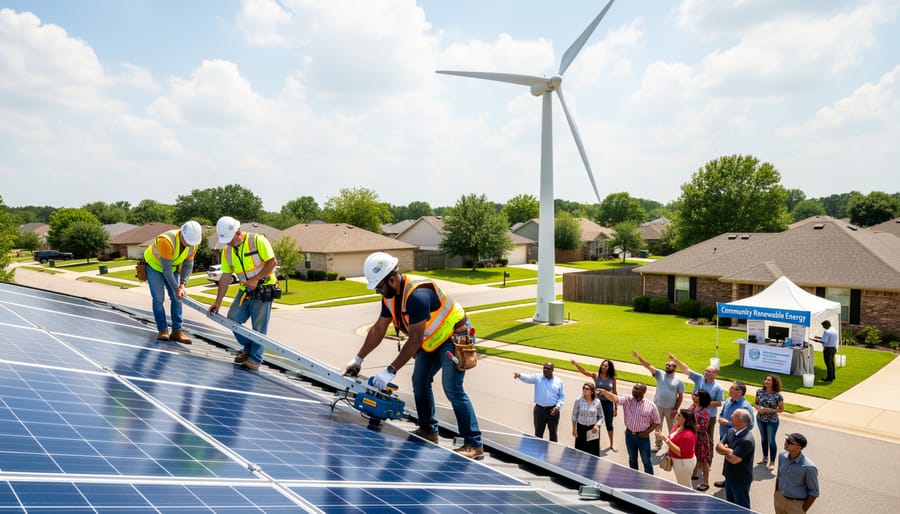
Rooftop solar panels transform individual homes into mini power plants, feeding excess electricity back into the grid or storing it in home batteries. Microgrids take this concept further: localized networks that can operate independently during outages, particularly valuable for remote communities or areas with unreliable grid access. Community solar projects pool resources so renters and those without suitable rooftops can still benefit from clean energy.
This model democratizes energy ownership, keeps more money circulating locally rather than flowing to distant corporations, and builds community resilience. Neighbors become stakeholders in shared renewable infrastructure, making the transition a collective effort rather than a top-down mandate.
Just Transition Approaches
Just transition approaches recognize that moving away from fossil fuels affects real workers, families, and communities whose livelihoods depend on coal mines, gas plants, and related industries. These equity-centered pathways deliberately address the social impacts of energy transitions rather than treating displaced workers as collateral damage.
Effective just transitions combine immediate economic support with long-term opportunity creation. Worker retraining programs help coal miners and power plant technicians acquire renewable energy skills, from solar installation to wind turbine maintenance. Community investment funds redirect fossil fuel tax revenues toward local economic diversification, building new industries before old ones disappear.
Crucially, just transitions involve affected communities in planning decisions rather than imposing changes from above. This means genuine consultation with labor unions, Indigenous communities, and frontline populations to shape transition timelines and ensure benefits reach those most impacted. Germany’s coal phase-out included guaranteed employment support and regional development funds negotiated directly with mining communities, demonstrating how deliberate equity measures can build broader public support for necessary energy system transformation.
Leapfrog Transitions in Developing Regions
Developing regions without established fossil fuel infrastructure face what seems like a disadvantage, but it’s actually an opportunity. These areas can skip the carbon-intensive industrialization path entirely and build modern energy systems around renewables from the start, much like they leapfrogged landline telephones straight to mobile networks.
Off-grid solar installations in rural Sub-Saharan Africa now power homes, schools, and health clinics that never had reliable electricity. Bangladesh has deployed over 6 million solar home systems since 2003, bringing power to communities where extending the central grid would take decades and cost billions. Island nations in the Pacific are constructing renewable microgrids as their primary energy infrastructure, avoiding the fossil fuel dependency that created stranded assets elsewhere.
This leapfrog approach delivers faster energy access at lower cost while preventing the lock-in of polluting systems. Development banks and climate finance increasingly support these renewable-first pathways, recognizing they offer sustainable development without repeating the mistakes of fossil-dependent industrialization.
Where Renewable Energy Transitions Are Being Applied
Renewable energy transitions are not abstract policy goals, they’re concrete transformations happening right now across every continent and in every sector of the economy. Understanding where these shifts are taking place reveals both the scale of the challenge and the breadth of solutions already underway.
The most visible applications occur at the national level, where entire countries are restructuring their power systems. Germany’s Energiewende has replaced nearly half its electricity generation with renewables since 2000, while Costa Rica regularly runs on 100% renewable electricity for months at a time. Scotland generated enough wind power in 2023 to power every home twice over, and Uruguay transformed its grid from 90% fossil fuels to 95% renewables in just fifteen years.
But transitions extend far beyond national grids into nearly every corner of modern life:
- National power grids replacing coal and gas baseload with wind, solar, and storage
- Industrial operations switching to renewable electricity and green hydrogen for heavy manufacturing
- Transportation electrification through electric vehicle adoption and renewable-powered public transit
- Heating and cooling systems transitioning from gas furnaces to electric heat pumps
- Rural electrification projects bringing solar mini-grids to previously off-grid communities
- Island nations achieving energy independence by replacing imported diesel with local renewables
- Corporate renewable commitments driving direct investment in solar and wind projects
- Municipal climate action plans converting city operations and buildings to clean energy
These applications span vastly different scales and contexts. In Kenya, M-KOPA has connected over three million homes to affordable solar power through pay-as-you-go systems, leapfrogging the need for centralized grid infrastructure. Meanwhile, entire industrial sectors are transitioning: steel manufacturers are piloting green hydrogen to replace coking coal, cement plants are electrifying kilns, and data centers are signing record-breaking renewable power purchase agreements to meet their massive energy demands.
Transportation represents another critical frontier. Norway now sells more electric vehicles than gas-powered cars, China operates hundreds of thousands of electric buses, and ports worldwide are electrifying cargo handling equipment and shore power for docked ships. Even aviation is beginning its transition, with sustainable aviation fuels and early electric aircraft prototypes entering service.
Communities are also driving transitions from the ground up. Indigenous nations in Canada are developing wind and solar projects on their territories, replacing diesel generators and creating local employment. Neighborhoods in Brooklyn share solar energy through community microgrids, and towns across Europe have formed energy cooperatives that collectively own renewable installations and keep profits local. These grassroots efforts prove that transitions don’t require top-down mandates, they can emerge from community determination and collective action.
Key Challenges and How Communities Are Overcoming Them
Renewable energy transitions face real hurdles, but communities worldwide are proving these challenges aren’t insurmountable. Understanding both the obstacles and the solutions already working helps demystify the path forward and shows how collective action drives progress.
Infrastructure Gaps and Grid Modernization
Aging transmission systems built for centralized fossil fuel plants struggle to handle distributed renewable generation. Many grids can’t accommodate the two-way power flow from rooftop solar or manage rapid changes in wind output. Communities are addressing this through smart grid technologies that use real-time data to balance supply and demand. Regional transmission organizations in the U.S. Midwest have implemented advanced forecasting systems that predict wind and solar output hours ahead, allowing utilities to adjust conventional generation accordingly. Local governments are also forming energy cooperatives that pool resources to upgrade neighborhood-level infrastructure without waiting for utility action.
Intermittency and Energy Storage
The “the sun doesn’t always shine” concern has driven remarkable battery innovation. Lithium-ion costs have dropped 90% since 2010, making utility-scale storage economically viable. Communities in remote areas now pair solar installations with battery systems that provide reliable power through the night. California’s residential time-of-use rates incentivize homeowners to store midday solar energy for evening use, effectively creating thousands of small grid stabilizers. Pumped hydro storage and emerging technologies like compressed air systems offer additional backup options that work alongside batteries.
Financing and Economic Barriers
High upfront costs deter many potential adopters despite long-term savings. Community solar programs solve this by allowing multiple households to share one installation’s benefits without individual rooftop systems. Green banks, public financing institutions dedicated to clean energy, now operate in several states, offering low-interest loans that make projects financially accessible. Power purchase agreements let businesses install solar with zero upfront cost, paying only for the electricity generated at rates lower than grid power.
Workforce Transition and Political Resistance
Coal communities understandably worry about job losses. Successful transitions include robust retraining programs that leverage existing skills, electricians transition to solar installation, engineers shift to grid optimization. The Appalachian region has launched multiple initiatives placing former coal workers in renewable energy jobs with comparable wages. Building broad political support requires demonstrating local economic benefits, creating good jobs, and ensuring vulnerable communities benefit first rather than bearing disproportionate costs. When communities see neighbors thriving in new energy sectors, resistance softens into participation.
Common Questions About Renewable Energy Transitions
Communities navigating renewable energy transitions consistently ask similar questions about the practical realities, trade-offs, and timelines of shifting away from fossil fuels. These concerns are valid and deserve straightforward answers grounded in real-world evidence rather than idealized projections.
How long do renewable energy transitions actually take?
Complete energy system transitions typically unfold over 20 to 40 years, though specific sectors can transform faster, some regions have shifted electricity generation to majority renewable in just 10 to 15 years when policy, investment, and infrastructure align. The timeline depends heavily on existing infrastructure, political commitment, financing availability, and whether communities pursue incremental change or accelerated deployment.
Can renewable energy provide reliable baseload power?
Modern renewable energy systems achieve reliability through strategic combinations of generation diversity (solar, wind, hydro working together across different weather patterns), grid-scale battery storage, demand-side management, and maintained transmission interconnections. Countries like Denmark and Uruguay already meet 70 to 100 percent of electricity demand from renewables for extended periods by deploying these integrated solutions rather than relying on single technologies.
What happens to workers in fossil fuel industries?
Just transition frameworks prioritize retraining programs, early retirement packages, and guaranteed employment pathways into renewable energy sectors for displaced workers. Evidence from regions like Germany’s Ruhr Valley and Scotland’s offshore wind industry shows that proactive investment in workforce development creates more renewable energy jobs than are lost in fossil fuel phase-outs, though the transition requires deliberate policy attention and adequate funding to prevent communities from being abandoned.
How can individuals support renewable energy transitions in their communities?
Participate in local energy cooperatives or community solar programs, advocate for renewable energy policies through municipal and regional decision-making processes, and make your home more energy-efficient to reduce overall demand. You can also track CO2 units in carbon markets to better understand how emissions reductions connect to policy mechanisms, or invest in green bonds that fund renewable infrastructure in your region.
The cost question deserves additional attention because affordability concerns often dominate public discussion. Renewable energy has become the cheapest source of new electricity generation in most markets worldwide, with solar and onshore wind consistently undercutting coal and gas on pure generation costs. The transition’s total expense includes grid upgrades, storage deployment, and workforce programs, but these investments prevent far greater costs down the line, unmanaged climate impacts, health burdens from air pollution, and continued fossil fuel price volatility. Communities that delay transitions face compounding expenses as extreme weather damages infrastructure and fossil fuel dependence becomes increasingly expensive to maintain.
Energy storage’s role cannot be overstated. Battery systems, pumped hydro storage, and emerging technologies like green hydrogen allow renewable-heavy grids to balance supply and demand across hours, days, and seasons. Storage costs have dropped over 80 percent in the past decade, making once-theoretical renewable baseload capacity an operational reality in leading transition regions.
The path from fossil fuels to renewable energy represents one of the most significant transformations in human history, and it’s already underway in communities across the globe. What we’ve explored isn’t a distant future scenario, it’s happening now, driven by technical innovation, economic reality, and the collective determination of people who refuse to accept climate injustice as inevitable.
Renewable energy transitions aren’t simple or uniform. They demand coordinated changes across technology, policy, finance, and community structures. But that complexity is also the source of their strength. When transitions prioritize equity, ensuring workers find new opportunities, communities gain energy sovereignty, and vulnerable populations aren’t left behind, they become powerful engines of social progress, not just carbon reduction.
The encouraging reality? Transitions work. Countries and regions demonstrating that reliable, affordable renewable energy systems can replace fossil fuel infrastructure at scale. Costs continue dropping. Storage technology keeps improving. Communities are proving that distributed, democratic energy systems can deliver both climate solutions and local economic benefits.
Your role in this transformation matters. Engage with renewable energy initiatives in your community. Support policies that accelerate fair transitions. Consider carbon offset projects that fund renewable infrastructure in underserved regions. Ask your utility about renewable energy programs. Vote for leaders committed to climate action.
The renewable energy transition isn’t something to wait for, it’s something to join. Every solar installation, every policy victory, every community that claims energy independence brings us closer to a just, sustainable energy future. Mining the Sun exists to support that journey with practical information, community connection, and resources that turn awareness into action.