
Calculate your daily energy consumption in watt-hours by reviewing your electricity bills or using a power monitor to track actual usage over several days. Multiply this figure by the number of days you want backup power (typically 1-3 days for most residential systems), then divide by your battery’s depth of discharge rating. For example, if you use 30,000 watt-hours daily and want two days of autonomy with lithium batteries rated at 80% depth of discharge, you’ll need 75,000 watt-hours (or 75 kilowatt-hours) of battery capacity.
In the interest of transparency, we earn a commission on some purchases made through links on this site.
Match your battery bank voltage to your solar panel array configuration, whether that’s 12V, 24V, or 48V systems. Higher voltages reduce current flow and allow for smaller wire sizes, making 48V the standard for larger residential installations in 2026. Your battery capacity must align with what your charge controller can handle, and the total amp-hour rating should support your inverter’s continuous and peak power demands.
Account for temperature derating, particularly if batteries will be stored in unconditioned spaces. Lithium iron phosphate batteries lose about 10% capacity at freezing temperatures, while lead-acid batteries can lose 50% or more. This reality means you’ll need additional capacity beyond your calculated baseline if you live in regions with cold winters.
Size for your actual consumption patterns rather than theoretical maximums. Track when you use the most power throughout the day and whether your solar production aligns with that usage. Many households discover their evening consumption peaks hours after solar production stops, requiring larger battery banks than initially expected. The right battery size creates energy independence without overbuilding, balancing upfront costs with the resilience and peace of mind that comes from reliable backup power when you need it most.
Why Battery Sizing Matters for Your Solar Investment
Getting your battery size wrong is like building a house with the wrong-sized foundation. Too small, and your system can’t support the life you want to live. Too large, and you’ve poured resources into infrastructure you’ll never use.
An undersized battery bank means watching your lights flicker during cloudy stretches, or running a diesel generator when you’d planned to live fossil-fuel-free. You’ll discharge your batteries deeper than intended, shortening their lifespan and forcing premature replacements. The upfront savings from buying fewer batteries quickly disappear when you’re replacing them years earlier than expected. Worse, you’ve limited your energy resilience precisely when you need it most, during storms or grid failures that can last days.
Oversizing creates different problems. You’re spending thousands on capacity you’ll rarely tap, money that could have funded more solar panels, weatherization, or community energy projects. Batteries that consistently cycle at shallow depths don’t perform optimally either, and you’ve increased the environmental footprint of your system by manufacturing and installing resources you don’t genuinely need. The investment criteria for batteries in renewable systems emphasize matching capacity to actual needs rather than maximizing size.
Proper sizing hits the sweet spot. Your system delivers reliable power through typical weather patterns while maintaining healthy battery charge cycles. You’ve allocated your resources efficiently, maximizing both environmental impact and economic returns. A right-sized system means energy when you need it, batteries that last their full lifespan, and confidence that your investment truly serves your goals.
This isn’t just about personal economics. Communities making smart sizing decisions accelerate the renewable transition by demonstrating that solar-plus-storage works reliably and affordably. Every properly sized system becomes proof that energy independence is achievable, practical, and worth the effort.
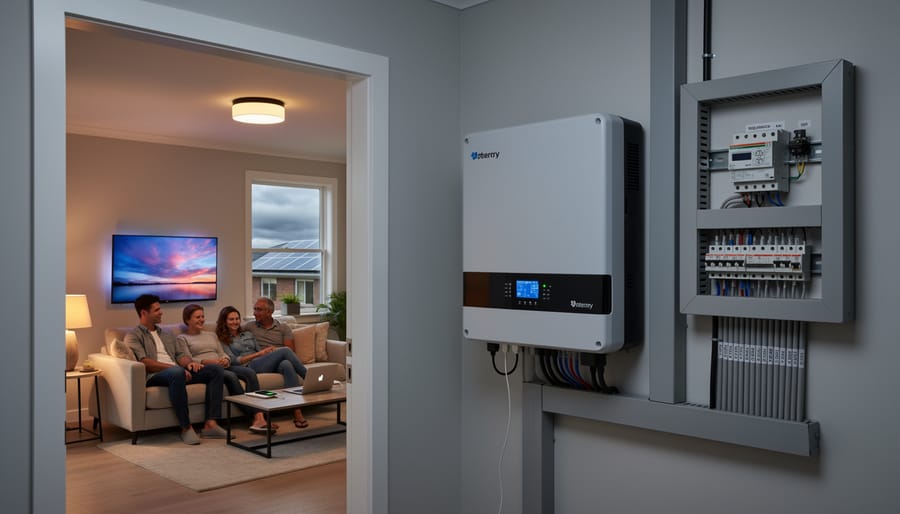
Understanding Your Energy Consumption: The Foundation of Battery Sizing
Identifying Your Critical Loads
Critical loads are the appliances and systems you absolutely need during a power outage or when your solar panels aren’t producing enough electricity. Identifying these loads shapes how much battery capacity you’ll actually need, rather than sizing for your entire household consumption.
Start by walking through your home during an imaginary outage. What would genuinely disrupt your safety, health, or essential activities? Most people discover their critical list is shorter than expected. A refrigerator preserves food and medication. LED lighting provides safety and functionality. A well pump in rural areas ensures water access. Medical equipment like CPAP machines or oxygen concentrators are non-negotiable. Phone and internet modems keep you connected during emergencies.
Write down each critical appliance’s wattage (found on labels or manuals) and how many hours daily you’d run it during low-solar periods. A refrigerator might use 150 watts but only runs 8 hours total due to its cycling. Your LED lights might draw 60 watts combined for 4 hours nightly.
This exercise reveals a liberating truth: you likely need far less battery capacity than your total home consumption suggests. A family using 30 kilowatt-hours daily might find their critical loads total only 5 kilowatt-hours. That difference dramatically affects your battery investment and sizing calculations.
Non-essential loads like electric dryers, air conditioning, electric water heaters, and entertainment systems can wait for sunny days when your panels are producing. This strategic prioritization connects your values with practical energy resilience.
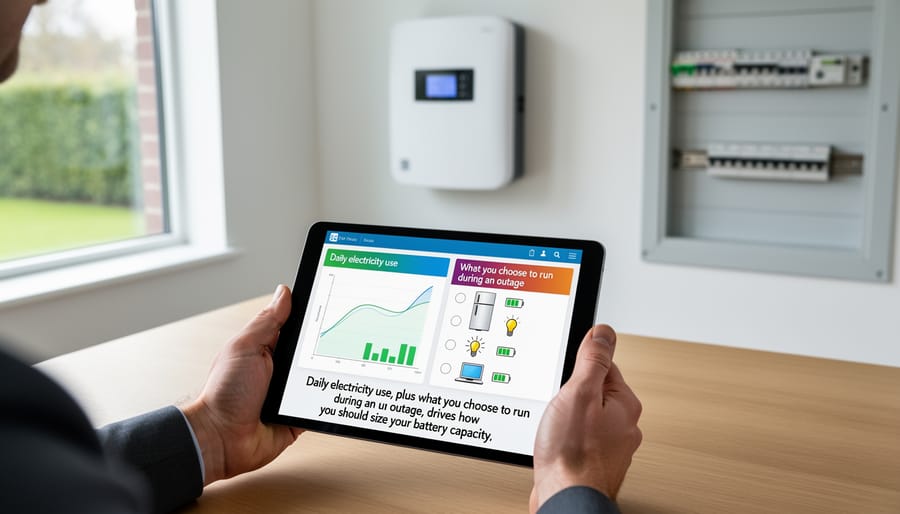
Accounting for Seasonal Variations
Your energy needs and solar production aren’t constants, they shift dramatically with the seasons, and ignoring this reality can leave you with an undersized battery when you need it most.
Winter typically brings the biggest challenge: shorter days and lower sun angles mean your panels generate substantially less power, sometimes 30-60% less than peak summer production. Meanwhile, your consumption often increases, heating systems run more, lights stay on longer, and in many climates, you’re indoors using appliances throughout darker mornings and evenings. This double squeeze of reduced generation and increased demand means your battery must bridge a much wider gap.
Summer presents the opposite scenario but still requires attention. Even though panels produce abundantly, consumption can spike with air conditioning, refrigeration working harder in heat, and irrigation systems running. The challenge shifts from scarcity to managing excess and ensuring your battery can absorb the surplus without waste.
When sizing batteries for solar panels, design for your worst-case month, typically December or January in the Northern Hemisphere. Calculate your expected daily deficit during this period: the gap between what your panels will realistically generate and what you’ll consume. Your battery capacity should comfortably cover this deficit for your chosen days of autonomy, not the more favourable spring or autumn averages. Building resilience into your system from the start means avoiding the frustration of running short during the season when backup power matters most.
How Solar Panel Output Affects Battery Requirements
Your solar panels are your energy factory, and your batteries are the warehouse that stores what you produce. Understanding the relationship between these two components is essential for building a solar system that actually works for your needs.
Think of it this way: if your panels generate more electricity than you can use during peak sunlight hours, that excess energy needs somewhere to go, or it’s simply lost. This is where proper solar panel sizing and battery capacity planning work hand in hand to capture and store every kilowatt-hour for later use.
Your geographic location dramatically affects both how much energy your panels produce and how much battery storage you’ll need. A homeowner in Phoenix gets roughly 300 sunny days per year and can rely on consistent solar production, meaning smaller battery reserves might suffice. Meanwhile, someone in Seattle faces frequent cloudy stretches and needs more battery capacity to bridge those grey periods. Local solar irradiance, the measure of how much sunlight reaches your specific location, determines your panels’ realistic output and therefore how quickly they can recharge your batteries.
Panel efficiency matters too. Modern panels in 2026 convert 20 to 23 percent of sunlight into electricity, but this efficiency varies by temperature, shading, and age. If your panels operate at lower efficiency due to partial shade or extreme heat, they produce less energy throughout the day. That means either installing more panels to compensate or accepting that your batteries will take longer to fully charge, which might require additional capacity to maintain energy security during consecutive low-sun days.
The seasonal angle of the sun also shifts how much energy your system generates. Winter months bring shorter days and lower sun angles, reducing panel output sometimes by 40 to 60 percent compared to summer peaks. Your battery bank needs to account for these seasonal valleys, not just the sunny days when everything works perfectly.
Getting this balance right means your batteries match what your panels can realistically deliver in your specific environment, creating a resilient system that serves you year-round.
The Battery Sizing Formula: Step-by-Step Calculation
Depth of Discharge and Battery Lifespan
Every battery has a limit to how much energy you can safely draw before recharging, measured as depth of discharge (DoD). Draining a battery to 80% DoD means you’ve used 80% of its total capacity. Push batteries too deep too often, and you’ll shorten their lifespan dramatically. This directly affects how much total capacity you need to install when sizing batteries for solar panels.
Lead-acid batteries typically tolerate only 50% DoD if you want decent longevity, meaning a 10 kWh lead-acid bank effectively gives you 5 kWh of usable energy. Modern lithium-ion batteries handle 80-90% DoD without significant degradation, so that same 10 kWh provides 8-9 kWh you can actually use. The math matters: if your calculations show you need 6 kWh of daily storage, you’d need a 12 kWh lead-acid system but only a 7.5 kWh lithium system.
| Battery Type | Recommended DoD | Expected Cycles | Typical Lifespan |
|---|---|---|---|
| Flooded Lead-Acid | 50% | 1,500-2,000 | 5-7 years |
| Sealed Lead-Acid (AGM) | 50% | 500-1,000 | 3-5 years |
| Lithium Iron Phosphate (LiFePO4) | 80-90% | 4,000-6,000 | 10-15 years |
| Lithium NMC | 80% | 3,000-5,000 | 10-12 years |
Understanding battery efficiency alongside DoD gives you the complete picture. A battery rated for 3,000 cycles at 80% DoD will deliver far more lifetime energy than one rated for 1,500 cycles at 50% DoD, even if the upfront cost runs higher. Factor both the usable capacity and expected replacement timeline into your sizing calculations, choosing the wrong chemistry can double your required capacity or halve your system’s working life.
Determining Days of Autonomy
Days of autonomy refers to how many consecutive days your battery system can power your home without any solar input. This critical decision balances peace of mind against system cost and complexity.
In regions with reliable sunshine year-round, two to three days of autonomy typically suffices. Areas prone to extended cloudy periods, such as Pacific Northwest winters or monsoon seasons, may warrant four to five days. Consider your local climate patterns: track how many consecutive low-sun days you experience annually to set a realistic baseline.
Grid reliability also shapes this decision. If you maintain grid connection and rarely experience outages, one to two days of autonomy provides adequate backup. Off-grid households or those in areas with frequent power disruptions often choose three to five days. Your personal risk tolerance matters here: some households prioritize minimizing initial costs, while others value complete energy security during emergencies.
Remember that days of autonomy directly impacts your battery bank size and budget. Each additional day requires proportionally more storage capacity, affecting both upfront investment and considerations like solar inverter sizing. Start with your minimum comfort level, then adjust based on your specific circumstances and climate data rather than generic recommendations.
Choosing the Right Battery Type for Your Solar System
The battery chemistry you choose fundamentally changes how you size your solar storage system. Each technology stores and delivers energy differently, which means a 10 kWh lithium-ion battery doesn’t perform the same as a 10 kWh lead-acid bank.
Lithium-ion batteries dominate residential solar installations in 2026 for good reason. You can safely discharge them to 80-90% of their rated capacity without shortening their lifespan, meaning a 10 kWh lithium battery gives you 8-9 kWh of usable energy. They’re 95-98% efficient in both charge and discharge cycles, so very little energy gets lost as heat. Their compact size and lighter weight make installation easier, especially for retrofits or space-constrained homes. The main trade-off is upfront cost, though prices have dropped substantially as manufacturing scales up.
Lead-acid batteries, both flooded and sealed AGM types, remain viable for off-grid applications and budget-conscious projects. However, you should only discharge them to 50% of rated capacity to preserve their lifespan, meaning that same 10 kWh nominal capacity only delivers 5 kWh usable. They’re less efficient at 80-85%, losing more energy to heat during charging. You’ll need roughly twice the nominal capacity in lead-acid to match the usable capacity of lithium-ion, which affects your sizing calculations significantly. On the positive side, lead-acid technology is well-understood, widely recyclable (over 95% of lead-acid batteries get recycled in the U.S.), and costs less initially.
| Battery Type | Usable Capacity | Round-Trip Efficiency | Expected Lifespan | Sizing Multiplier |
|---|---|---|---|---|
| Lithium-ion (LFP) | 80-90% | 95-98% | 10-15 years / 6,000+ cycles | 1.1x |
| Lead-acid (flooded) | 50% | 80-85% | 3-7 years / 1,500 cycles | 2.0x |
| Lead-acid (AGM) | 50% | 85% | 4-8 years / 2,000 cycles | 2.0x |
| Saltwater (emerging) | 90-95% | 90% | 8-12 years / 5,000 cycles | 1.05x |
Emerging technologies like saltwater batteries offer a non-toxic, fully recyclable option that appeals to communities prioritizing environmental justice. They can be deeply discharged without damage and use abundant, non-hazardous materials. The catch is lower energy density, meaning they take up more physical space than lithium batteries for the same usable capacity.
Your choice shapes your sizing calculation directly. If your energy needs analysis determined you need 8 kWh of usable storage, you’d install roughly 9 kWh of lithium-ion capacity, 16 kWh of lead-acid, or 8.5 kWh of saltwater. Factor in efficiency losses too: to get 8 kWh out of a lead-acid bank, you actually need to generate and store about 9.4 kWh from your solar panels, versus 8.2 kWh for lithium-ion.
For most residential and community-scale projects in 2026, lithium iron phosphate batteries offer the best balance of performance, lifespan, and total cost of ownership. Lead-acid makes sense when upfront budget is extremely tight or for smaller, temporary installations. Emerging technologies deserve consideration if your values prioritize non-toxic materials and you have adequate space.
Real-World Sizing Examples: From Tiny Homes to Community Solar
Let’s walk through three real scenarios that demonstrate how to size batteries for solar panels across different scales, showing how the same principles work whether you’re powering a weekend cabin or a community center.
**Off-Grid Tiny Home (Weekend Use)**
Sarah’s 400-square-foot tiny home uses 3 kWh daily for LED lighting, a laptop, phone charging, and a small refrigerator. Her 1.5 kW solar array produces about 6 kWh on good summer days but only 2 kWh during winter. She wants two days of autonomy for cloudy weekends.
Calculation: 3 kWh daily × 2 days ÷ 0.8 (depth of discharge for lithium) ÷ 0.85 (system efficiency) = 8.8 kWh of usable capacity needed. Sarah installs a 10 kWh lithium battery, giving her comfortable headroom while her modest solar array can fully recharge the system during summer and partially during winter when she uses the home less frequently.
**Suburban Family Home (Grid-Tied with Backup)**
The Martinez family consumes 25 kWh daily. They prioritize backing up critical loads during outages: refrigerator, internet, some lighting, and medical equipment, totaling 8 kWh per day. They want one full day of backup with their 6 kW solar system providing daytime recharging.
Calculation: 8 kWh × 1 day ÷ 0.9 (lithium depth of discharge) ÷ 0.85 = 10.5 kWh. They install an 11 kWh battery that covers critical loads during grid outages and provides time-of-use optimization during normal operation, storing cheap overnight power or excess solar production.
**Community Resource Center (Full Off-Grid)**
A community center serving a rural neighborhood runs computers, WiFi, medical refrigeration, and meeting spaces, consuming 80 kWh daily. Their 20 kW solar array must sustain operations through three consecutive cloudy days.
Calculation: 80 kWh × 3 days ÷ 0.8 ÷ 0.85 = 353 kWh. They install 360 kWh of battery capacity split across modular units, ensuring reliable power for essential community services while supporting local climate resilience and energy sovereignty.
These examples show how sizing scales with needs while maintaining the same fundamental approach across all applications.
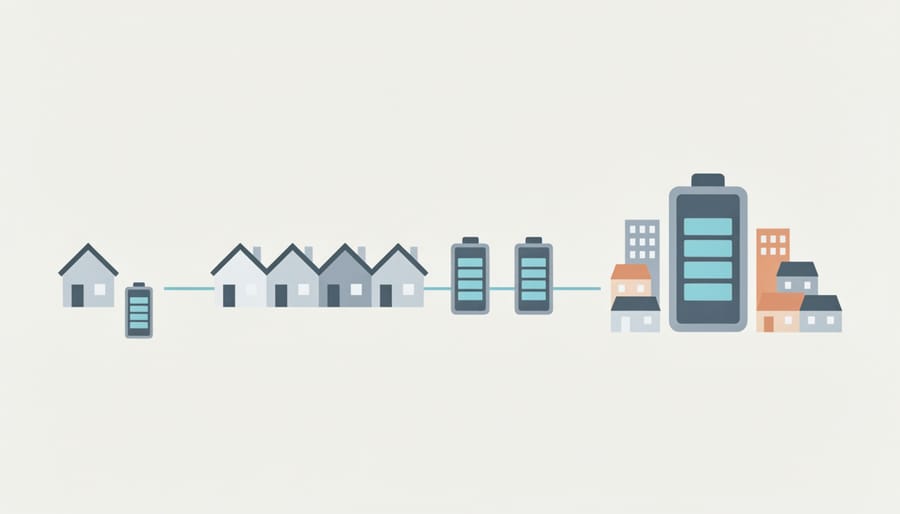
Common Battery Sizing Mistakes and How to Avoid Them
Even experienced installers sometimes stumble when sizing solar batteries. The most common mistake? Calculating based on nameplate capacity without accounting for efficiency losses. Real-world battery systems lose 10-20% of energy during charging and discharging cycles, plus inverter inefficiencies can claim another 5-10%. If you calculate needing 10 kWh of storage and install exactly that, you’ll find yourself short when the sun goes down.
Another frequent error is designing for average conditions rather than worst-case scenarios. Your battery system might work perfectly in April and September, but January’s shorter days and cloudy weather will expose the flaws. Always size for your least favorable month, not the annual average. This approach prevents the frustration of running your generator during winter or rationing electricity when you need it most.
Many people also forget to plan for growth. That 5 kWh system might cover your current needs, but what happens when you add an electric vehicle, expand your home office, or welcome a new family member? Building in 20-30% extra capacity costs less now than adding batteries later, especially when you factor in battery installation safety requirements and system reconfiguration expenses.
Ignoring depth of discharge limitations creates another pitfall. Regularly draining lithium batteries below 20% or lead-acid batteries below 50% dramatically shortens their lifespan. Your 10-year battery investment might only last five years if you consistently overdischarge. Calculate your usable capacity based on recommended DoD limits, not total capacity.
The solution? Build conservative estimates into every calculation. Round your daily consumption up, your solar production down, and your efficiency assumptions conservatively. Add a buffer for future expansion. This approach costs slightly more upfront but delivers reliable energy independence and prevents the expensive disappointment of an undersized system that never quite meets your needs.
Taking Action: Your Next Steps Toward Energy Independence
You’ve worked through the calculations, explored battery technologies, and learned to avoid common pitfalls. Now it’s time to transform that knowledge into action and join the growing community building a cleaner energy future.
Start by gathering three months of your utility bills to establish baseline consumption patterns. Use this data to run your battery sizing calculations with the formula we’ve covered, adjusting for your specific climate zone and critical loads. Many solar professionals offer free consultations that can validate your calculations and identify region-specific considerations you might have missed.
Beyond your individual system, consider how your solar investment contributes to broader energy justice. Share your sizing calculations and lessons learned with neighbors considering solar installations. Advocate for policies that expand solar access to underserved communities. Every properly sized battery system demonstrates that distributed, renewable energy works, and that proof builds momentum for systemic change.
The transition to renewable energy isn’t just about personal energy independence; it’s about creating resilient communities that can weather both climate impacts and grid failures. Your battery storage system becomes part of a larger solution, reducing fossil fuel dependence one installation at a time. By sizing your system correctly today, you’re not just optimizing your investment, you’re helping write the blueprint for our collective energy future.