
The six greenhouse gases are carbon dioxide (CO2), methane (CH4), nitrous oxide (N2O), hydrofluorocarbons (HFCs), perfluorocarbons (PFCs), and sulfur hexafluoride (SF6). Together they make up the basket of gases covered under the Kyoto Protocol, and each one traces back to specific human activities, which means each one also has a specific path to reduction.
CO2 comes mainly from burning fossil fuels and clearing land. Methane rises from livestock, landfills, and leaky energy infrastructure. Nitrous oxide escapes from fertilized fields and industrial processes. The last three, HFCs, PFCs, and SF6, are fluorinated gases from refrigeration, aluminum smelting, and electrical equipment. They’re released in small volumes, but they trap far more heat per molecule than CO2 and can linger in the atmosphere for decades to millennia.
Here’s the encouraging part. Knowing which gas comes from which sector turns a overwhelming problem into a set of solvable ones. A landfill manager, a farmer, a facilities engineer, and a city planner each hold a different lever.
Below, we explain how the list was chosen and ordered, then walk through each gas with its main emission sources and one practical reduction opportunity. A sector-to-gas table and a short FAQ follow, so you can scan for what matters to your work and your community.
How We Chose and Ordered These Six Gases
These six gases earned their place for a straightforward reason: they are the ones named under the Kyoto Protocol greenhouse gases framework, and they show up again and again in national inventories and carbon accounting. If you’ve seen an emissions report or a carbon credit methodology, you’ve seen this list at work.
We ordered them by overall contribution to warming, from the most widespread to the least. That’s why carbon dioxide leads and sulfur hexafluoride closes the list.
A few terms will help as you read:
– Greenhouse gas: a gas that traps heat in the atmosphere instead of letting it escape to space.
– Global warming potential (GWP): a score showing how much heat a gas traps compared with carbon dioxide, usually over 100 years.
– Atmospheric lifetime: roughly how long a gas lingers before natural processes break it down or remove it.
– CO2-equivalent (CO2e): a common unit that converts every gas into the amount of carbon dioxide that would cause the same warming, so different gases can be added together.
Water vapor and ozone also affect climate, so why aren’t they here? They respond to temperature and chemistry rather than being released directly by human activity in the same way, so they’re tracked differently. Leaving them out keeps this list focused on gases that sectors can measure, report, and reduce.
The Six Gases and the Sectors Behind Them
1. Carbon Dioxide (CO2): The Most Abundant Driver of Warming
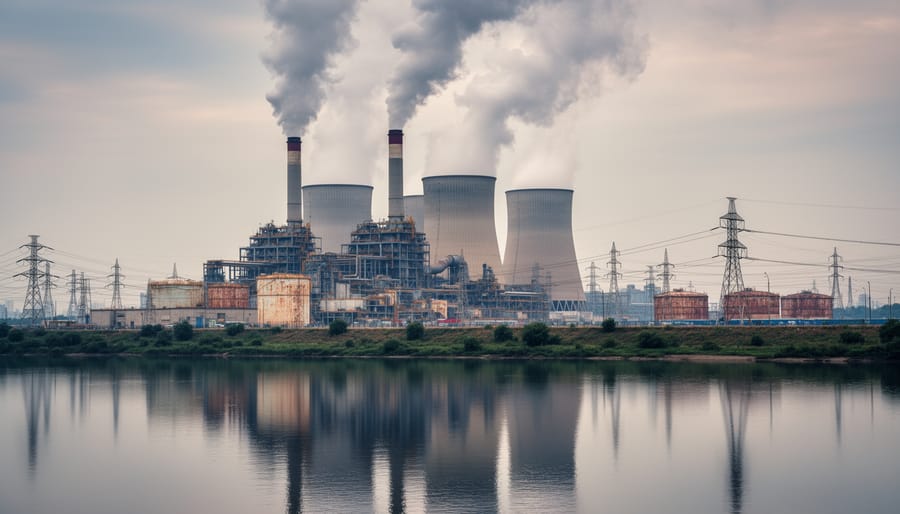
Carbon dioxide is what’s left when anything carrying carbon burns, whether that’s coal in a power plant, gasoline in an engine, or wood in a fire. It’s the most abundant of the six gases, and it’s the one most closely tied to how we power our daily lives. Here’s where it comes from:
- Electricity and heat: burning coal, oil, and gas to power homes and businesses is the largest single source.
- Transport: cars, trucks, ships, and planes release CO2 from every liter of fuel they burn.
- Industrial processes: steelmaking and cement production release CO2 both from fuel and from the chemical reactions themselves.
- Land-use change: clearing forests removes trees that absorb CO2 and often releases the carbon stored in them.
What makes CO2 so influential is staying power. A large share of what we emit lingers in the atmosphere for centuries, so today’s emissions keep warming the planet long after they leave the tailpipe or smokestack. That long life is also why scientists use CO2 as the yardstick for every other gas. When you see a global warming potential value, it asks a simple question: how does this gas compare with one unit of CO2?
Here’s the hopeful part. Because we know exactly where CO2 comes from, we know exactly where to act. Wind and solar are replacing fossil-fired electricity, efficiency upgrades are trimming the energy buildings and factories need, and protecting forests keeps stored carbon locked away while those trees keep absorbing more. Carbon market projects add another layer, channeling funding toward reforestation, clean cooking, and renewable energy in communities worldwide. Every one of these solutions goes straight at the source, and people everywhere can be part of them.
2. Methane (CH4): A Fast-Acting Gas With Fast-Acting Solutions
Methane is the gas with a sprinter’s profile. Pound for pound, it traps far more heat than carbon dioxide over a short window, yet it breaks down in the atmosphere in roughly a decade. That short lifespan is the key to its story, and it’s a hopeful one.
So where does it come from? Agriculture is a major source. Livestock release methane as they digest feed, and flooded rice paddies produce it as organic matter decomposes without oxygen. Oil and gas operations add to the total through leaks, venting, and flaring along wells, pipelines, and processing equipment. Coal mining releases methane trapped in the seams. And landfills and wastewater treatment plants generate it as organic waste breaks down in low-oxygen conditions.
Each source points to a practical fix. Leak detection and repair programs let oil and gas operators find and seal escaping gas, which keeps a valuable product from being wasted. Landfill gas capture turns methane into a fuel that can generate electricity or heat nearby homes and businesses. On farms, improved feed management, manure handling, and alternate wetting and drying in rice fields can all cut emissions without sacrificing productivity.
Because methane doesn’t linger, the benefits of these steps show up in the atmosphere within years rather than generations. Communities, utilities, farmers, and local governments can all take part, and many of these solutions already pay for themselves.
3. Nitrous Oxide (N2O): The Gas Hiding in Our Fields and Factories
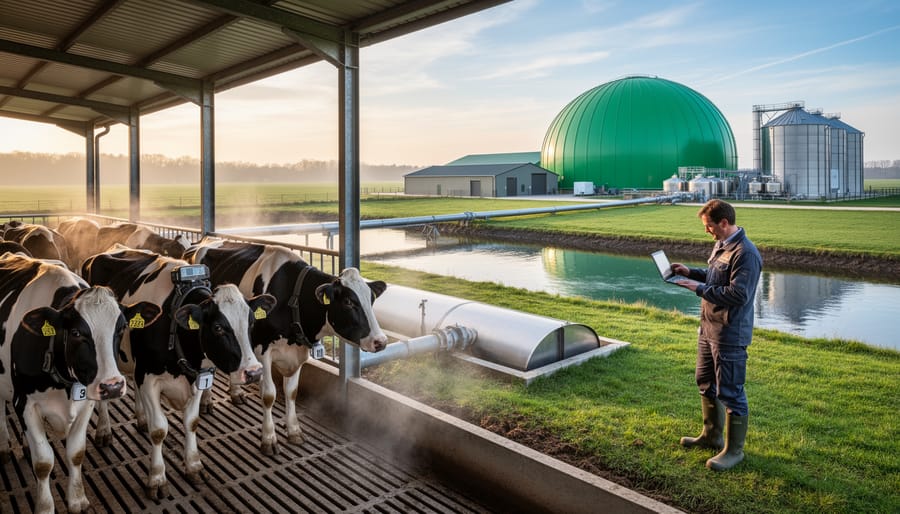
Nitrous oxide is the quiet heavyweight of the six gases. Pound for pound, it traps roughly 270 times more heat than carbon dioxide over a century, and it lingers in the atmosphere for well over a hundred years. It also does something CO2 does not: once it reaches the stratosphere, it becomes one of the leading substances depleting the ozone layer.
Most of it comes from the ground beneath our feet. When farmers apply synthetic fertilizers or spread manure, soil microbes convert the nitrogen their crops don’t absorb into N2O. That makes agriculture the largest source by a wide margin. Industry adds its share, particularly the production of nitric acid and the adipic acid used to make nylon. Burning fuels, including in vehicles and power plants, releases smaller amounts.
The encouraging part is that the biggest source is also the most manageable. Growers can make a real difference with a few proven practices:
– Match fertilizer to crop needs. Precision application, soil testing, and splitting doses across the season put nitrogen where plants can use it, so less escapes as gas.
– Plant cover crops. Roots hold onto leftover nitrogen between harvests and keep it out of the air and waterways.
– Build soil health. Healthy, well-aerated soil with plenty of organic matter supports microbes that release less N2O.
– Manage manure thoughtfully. Proper storage and timed application cut losses.
Many of these steps also lower input costs and improve yields, which is a win for farms and the communities that depend on them.
4. Hydrofluorocarbons (HFCs): The Cooling Sector’s Hidden Footprint

Hydrofluorocarbons, or HFCs, are synthetic gases that don’t occur in nature. They were created to solve one problem and ended up contributing to another. When the world moved away from ozone-damaging chemicals, HFCs became the go-to replacement in air conditioners, refrigerators, freezers, and aerosol sprays. They protected the ozone layer, but they turned out to be powerful heat-trappers.
Here’s what makes them unusual: even a small amount does a lot of warming. A single kilogram of some common HFCs traps far more heat than the same weight of carbon dioxide. That’s why a leaky refrigerator or a retired air conditioner that isn’t handled properly can matter more than its size suggests. The emission sectors most tied to HFCs are buildings and cooling, food storage and transport, and the manufacturing of cooling equipment.
The good news is that this is a story of progress already underway. Under the Kigali Amendment, countries around the world have agreed to phase HFCs down step by step. That agreement is pushing industry toward better options:
– Lower-impact refrigerants that cool just as well with a much smaller warming effect
– Careful recovery and recycling of refrigerant when old equipment is serviced or retired
– Efficient cooling design, such as good insulation, shading, and right-sized systems, that reduces how much cooling we need in the first place
Because HFC use is concentrated in a few product types, technicians, building managers, and everyday households all have a real role to play.
5. Perfluorocarbons (PFCs): Industrial Gases With Centuries-Long Staying Power
Perfluorocarbons, or PFCs, are synthetic gases built from carbon and fluorine. They don’t occur in nature, and they show up in the atmosphere almost entirely as byproducts of two industrial activities: aluminum smelting and semiconductor manufacturing.
In aluminum production, PFCs form during what’s called an “anode effect.” When the alumina feeding a smelting cell runs low, the process briefly shifts and releases carbon tetrafluoride and hexafluoroethane. In chip fabrication, similar gases are used to etch patterns into silicon and to clean the chambers where components are made.
What sets PFCs apart is their staying power. Think of a ship that can’t turn around once it leaves port. These gases are so chemically stable that sunlight and natural atmospheric processes barely break them down, so what we release today can keep trapping heat for thousands of years. Some PFCs outlast entire civilizations, which makes every avoided release a lasting gift to future generations.
Here’s the encouraging part: these are tightly controlled industrial processes, which means solutions are well within reach. Aluminum producers have cut emissions sharply by improving how they monitor and feed their smelting cells, catching anode effects before they start. Semiconductor makers are adopting gas abatement systems that destroy PFCs before they escape, along with alternative cleaning chemistries. Each upgrade shows that targeted engineering can quickly shrink a gas that would otherwise linger for ages.
6. Sulfur Hexafluoride (SF6): Small Volumes, Outsized Impact
Sulfur hexafluoride is a colorless, odorless gas with one very useful talent: it insulates electricity exceptionally well. That’s why it fills the sealed switchgear, circuit breakers, and substations that keep power flowing safely through transmission and distribution networks. It also shows up in smaller roles in some manufacturing processes, but the grid is where nearly all of the story plays out.
Here’s the catch. Per unit, SF6 is the most potent of the six gases. Its global warming potential is in the tens of thousands of times that of CO2, and it lingers in the atmosphere for thousands of years. The volumes released are tiny compared with CO2, yet a single leaking breaker can carry a surprisingly large climate footprint. Think of it as a very small spill of something extremely concentrated.
This is why leak management matters so much. Because SF6 sits inside closed equipment, emissions come mostly from slow leaks, maintenance handling, and end-of-life disposal. Those are all things utilities can control.
The practical solutions are already available:
– Continuous gas-density monitoring to catch leaks early
– Careful recovery and recycling during servicing and decommissioning
– SF6-free switchgear that uses alternative insulating gases or clean air and vacuum technology
For the energy sector, this is a clear win: protect grid reliability while quietly shrinking one of the most powerful warming agents we know.
Reading the Big Picture: Which Sectors Release Which Gases
Once you know each gas, a pattern shows up: no sector releases just one. Here is a quick way to see who emits what.
- Energy: CO2 from burning fuels, methane from oil, gas, and coal operations, and SF6 from grid equipment.
- Transportation: mostly CO2, with small amounts of nitrous oxide and methane from fuel combustion, plus HFCs from vehicle air conditioning.
- Agriculture and land use: methane from livestock and rice, nitrous oxide from fertilizers and manure, and CO2 from deforestation.
- Industry: CO2 from cement and steel, nitrous oxide from chemical production, and PFCs from aluminum smelting and semiconductors.
- Buildings and cooling: HFCs from refrigeration and air conditioning, plus CO2 from heating.
- Waste: methane from landfills and wastewater.
Notice how often a single sector shows up beside several gases. A farm, for example, can cut methane through better feed and manure handling while also trimming nitrous oxide with smarter fertilizer use. That overlap is good news, because one well-planned change can ease more than one problem at once.
It also explains why a whole-system approach works best. Tools like emissions trading put a price on carbon across many sectors at once, giving every industry a reason to find its own cleanest path.
Common Questions About the Six Greenhouse Gases
Many readers come to this topic with the same handful of questions, so here are friendly answers to the ones that come up most.
Why aren’t water vapor and ozone on this list?
Both influence climate, but they are tracked differently. Water vapor responds to temperature rather than being released directly by human activity, and ozone forms through chemical reactions in the air, so inventories focus on the six gases people emit directly.
What does CO2-equivalent mean?
It is a common yardstick that converts each gas into the amount of CO2 that would trap the same heat over a set period. That lets us add methane, nitrous oxide, and the others into one comparable total.
Why do small amounts of HFCs, PFCs, and SF6 matter so much?
These synthetic gases trap far more heat per molecule than CO2, and PFCs and SF6 linger for a very long time. Even modest leaks therefore carry a big climate footprint, which is why leak prevention and better equipment pay off quickly.
How do carbon markets and offset projects relate to these gases?
Offset projects measure reductions in CO2-equivalent, so cutting methane at a landfill or capturing industrial gases can earn credits just like protecting a forest. If you want to see how carbon markets connect and expand climate impact, or how to track CO2 units across them, those guides are a great next stop.
Still curious about a term? Our climate glossary breaks down the jargon in plain language, and our coverage of offset project opportunities shows how individuals, businesses, and communities can take part. Learning these basics is a real first step toward acting on them.
Final Takeaway: Knowing the Gases Helps Communities Act
Six gases can feel like a huge, abstract problem until you see where each one actually comes from. Once you can link a gas to a sector, the picture changes: methane from a landfill, nitrous oxide from a field, HFCs from an air conditioner. Each is a specific source with a specific fix, and plenty of people are already working on them.
That curiosity is a strong place to start. Browse the glossary to get comfortable with the terms, then follow our coverage of carbon markets and renewable energy to see how solutions are scaling. From there, look for community-focused initiatives and offset projects near you. Every project that captures methane, protects a forest, or upgrades a cooling system starts with someone who understood the problem well enough to act, and you can be that person.