
GHG emission reduction is the deliberate process of lowering the amount of greenhouse gases released into the atmosphere through changes in energy systems, industrial practices, transportation, land use, and consumption patterns. These gases, primarily carbon dioxide, methane, and nitrous oxide, trap heat in the Earth’s atmosphere and drive climate change. Reducing them is no longer optional for governments, businesses, or communities aiming to limit global temperature rise and its cascading impacts.
The challenge is real, but so is the momentum. By 2026, emission reduction has evolved from a theoretical target into a set of practical, measurable strategies deployed across every sector of the economy. From switching coal plants to renewable energy and capturing carbon at the source to redesigning supply chains and restoring forests, the pathways are varied and increasingly proven. What matters now is understanding which methods work, how they interact, and where your effort or investment can make the greatest difference.
This article walks you through the mechanics of GHG emission reduction, the major methodologies that deliver results, and the real-world contexts where they’re applied. Whether you’re a sustainability professional shaping corporate strategy, an educator seeking clarity for your students, or an engaged citizen exploring climate solutions, you’ll find the frameworks and insights needed to turn knowledge into action. The science is settled. The tools are ready. What remains is the collective will to deploy them at scale.
Understanding GHG Emission Reduction
Greenhouse gas emission reduction is the measurable decrease in the release of gases that trap heat in Earth’s atmosphere, driving global temperature rise and climate disruption. When we talk about reducing emissions, we’re focusing on cutting the actual amount of these gases released into the air through human activities, rather than simply offsetting them elsewhere. This distinction matters because reduction addresses the root cause of climate change by preventing emissions from entering the atmosphere in the first place.
The primary greenhouse gases targeted for reduction include carbon dioxide from burning fossil fuels, methane and nitrous oxide from agriculture and industrial processes, and fluorinated gases from refrigeration and manufacturing. While carbon dioxide gets the most attention, methane traps roughly 28 times more heat over a century than CO2, making it a critical target for near-term climate action. Nitrous oxide, meanwhile, has nearly 300 times the warming potential of carbon dioxide and persists in the atmosphere for over a century.
- GHG Emissions
- The release of gases that trap heat in Earth’s atmosphere, primarily carbon dioxide, methane, nitrous oxide, and fluorinated gases from human activities like energy production, agriculture, and manufacturing.
- Emission Reduction
- The measurable decrease in greenhouse gas releases through changes in energy sources, processes, behaviors, or technologies, distinct from offsetting or compensating for emissions elsewhere.
- Carbon Footprint
- The total amount of greenhouse gas emissions caused directly and indirectly by an individual, organization, event, or product, typically measured in tons of carbon dioxide equivalent.
- Baseline Emissions
- The starting measurement of greenhouse gas emissions before implementing reduction strategies, establishing the reference point for tracking progress and verifying actual decreases.
Reducing these emissions is essential for limiting global temperature rise to 1.5 or 2 degrees Celsius above pre-industrial levels, the thresholds scientists identify as critical for avoiding catastrophic climate impacts. Beyond the science, emission reduction is fundamentally about climate justice. Communities that have contributed least to historical emissions often face the harshest consequences of climate disruption, from extreme weather to displacement. By cutting emissions now, we protect these frontline communities while creating healthier, more equitable societies for everyone.
How GHG Emission Reduction Works
Measuring Your Carbon Baseline
Before you can reduce emissions, you need to know where you stand. Establishing a carbon baseline means calculating the total greenhouse gases your activities produce in a year, this becomes your reference point for measuring progress.
The process begins with carbon accounting, which tracks emissions across three defined scopes. Scope 1 covers direct emissions you control, like fuel burned in company vehicles or on-site boilers. Scope 2 includes indirect emissions from purchased electricity, heating, and cooling. Scope 3, often the largest and trickiest category, encompasses everything else in your value chain, from the materials you buy to how customers use your products. The Scope 3 accounting methodology provides detailed guidance for tackling these complex upstream and downstream emissions.
Most organizations start with a greenhouse gas inventory, gathering data on energy bills, fuel purchases, waste generation, and travel. Individuals can use simplified carbon calculators that estimate household emissions from similar inputs. The key is consistency, use the same boundaries and methods each year so you can track real change, not just accounting variations.
Setting Reduction Targets
Once you know your baseline, the next step is setting reduction targets that are ambitious yet achievable. The most credible approach involves science-based net-zero targets that align with the Paris Agreement’s goal of limiting warming to 1.5°C. These targets typically require reducing absolute emissions by 4.2% annually across all scopes, with specific milestones at 2030 and 2050.
Start by determining your target timeline. Near-term targets (5-10 years) drive immediate action, while long-term commitments (2040-2050) guide strategic planning. Consider your industry’s typical reduction pathways and the availability of solutions in your sector. A manufacturing company might set more aggressive scope 1 and 2 targets first, while a service business may prioritize scope 3 reductions from suppliers and business travel.
Your targets should be absolute rather than intensity-based when possible, meaning total emissions decrease regardless of growth. Break overall goals into specific reduction percentages for each emission scope, and identify the methodologies you will deploy to achieve them. The most effective targets balance scientific necessity with operational reality while pushing beyond business-as-usual improvements.
Types of Emission Reduction Methodologies
Energy Efficiency and Conservation
Energy efficiency and conservation represent the fastest, most cost-effective pathway to emission reduction available today. Rather than generating cleaner energy, these approaches focus on using less energy in the first place, a strategy that delivers immediate climate benefits while cutting operational costs.
Building envelope improvements offer substantial gains: upgrading insulation, sealing air leaks, and installing high-performance windows can slash heating and cooling demands by 30-50%. Equipment upgrades matter too. Replacing outdated HVAC systems, lighting, and appliances with ENERGY STAR-certified alternatives typically reduces consumption by 20-40% while improving performance.
Operational optimization fine-tunes how systems run. Smart thermostats learn usage patterns and adjust automatically. Timers prevent equipment from running unnecessarily. Regular maintenance keeps machinery operating at peak efficiency instead of wasting energy through degraded performance.
Behavioral changes amplify technical improvements. Simple habits, turning off unused lights, unplugging phantom loads, adjusting thermostats by a few degrees, compound into meaningful reductions across thousands of daily decisions. The beauty of efficiency work is that it pays for itself through lower energy bills while shrinking your carbon footprint, making it accessible regardless of budget constraints.
Renewable Energy Transition
Transitioning to renewable energy represents one of the most effective pathways for cutting greenhouse gas emissions across residential, commercial, and industrial applications. At the household level, rooftop solar installations can eliminate dependence on grid electricity generated from coal or natural gas, typically reducing a home’s carbon footprint by 3-4 tons annually. Community solar projects extend these benefits to renters and those without suitable roofs, pooling subscribers to share clean energy from centralized arrays.
For businesses, power purchase agreements with wind farms provide reliable renewable electricity at scale, often with cost savings that improve over time as fossil fuel prices fluctuate. Manufacturing facilities increasingly install on-site solar or procure renewable energy certificates to decarbonize operations while hedging against energy cost volatility.
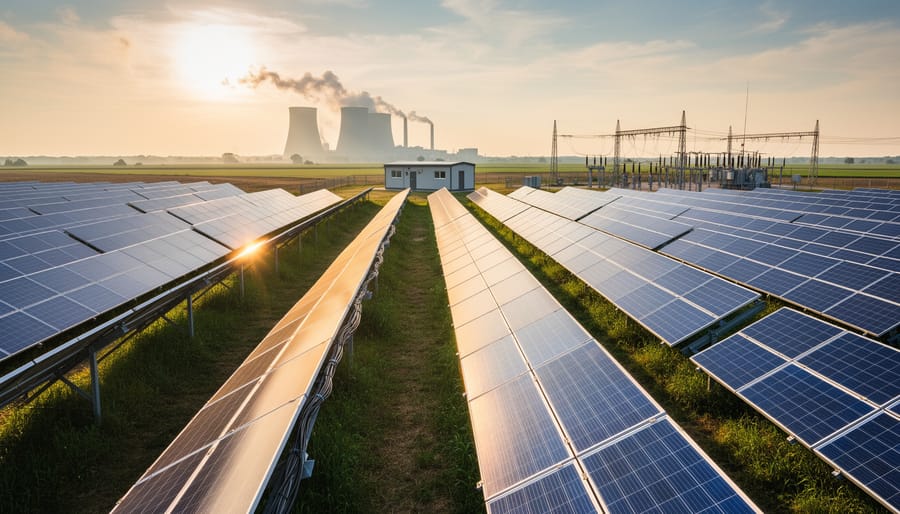
Grid-scale renewable deployment transforms entire regional energy systems. Utility-scale wind and solar farms, backed by battery storage systems, can replace coal plants entirely. Geothermal facilities provide steady baseload power in volcanically active regions, while offshore wind developments tap consistent ocean breezes. Each megawatt-hour of renewable electricity prevents roughly half a ton of CO2 from entering the atmosphere, making this transition fundamental to climate stabilization.
Industrial Process Innovation
Industrial innovation transforms heavy polluters into efficiency leaders. Manufacturing and chemical industries traditionally account for roughly 20-30% of global emissions, but breakthrough process redesign cuts that dramatically.
Cement and steel production illustrate the shift. Carbon capture systems now trap CO2 before it escapes smokestacks, while hydrogen-based steel production replaces coal entirely. Chemical manufacturers reduce emissions by switching feedstocks, optimizing reaction conditions, and recovering waste heat that once disappeared into the atmosphere.
Process integration presents another win. Industrial symbiosis connects facilities so one plant’s waste becomes another’s raw material, slashing both emissions and costs. Refineries, for instance, share steam networks and recover hydrogen previously vented or flared.
Electrification replaces fossil fuel burners with heat pumps and electric furnaces, particularly effective when paired with renewable energy. Meanwhile, digital twins and AI-powered controls optimize operations in real time, eliminating inefficiencies that drive excess emissions. These shifts demand upfront investment but deliver measurable reductions and often improve margins.
Transportation and Mobility Solutions
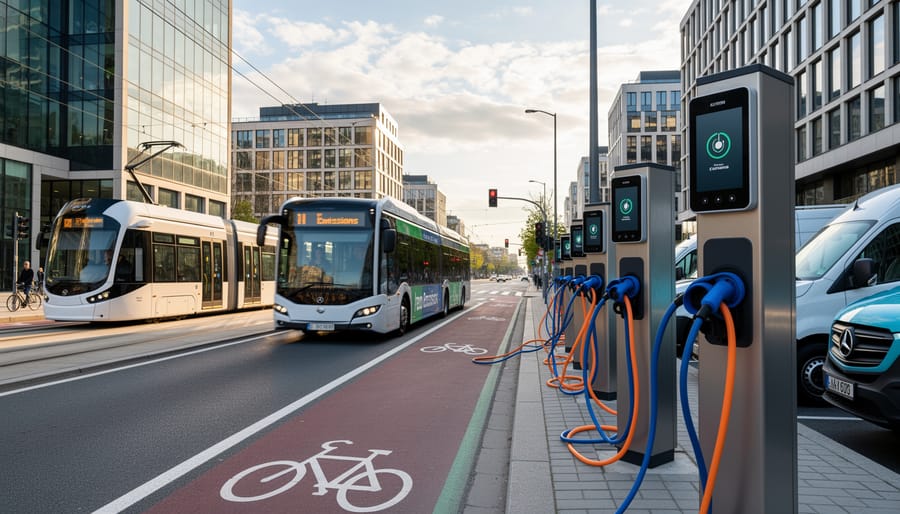
Transportation accounts for nearly a quarter of global CO2 emissions, making mobility solutions critical to any emission reduction strategy. Electrification leads the transformation: switching to electric vehicles eliminates tailpipe emissions and, when powered by renewable energy, creates a zero-carbon transportation system. Battery technology improvements now make EVs viable for personal vehicles, delivery fleets, and increasingly for heavy-duty trucks and buses.
Alternative fuels bridge the gap where electrification faces challenges. Hydrogen fuel cells power long-haul trucking and maritime shipping, while sustainable aviation fuels reduce emissions from air travel by up to 80% compared to conventional jet fuel. Biodiesel and renewable natural gas offer immediate emission cuts for existing vehicle fleets.
Public transit expansion delivers outsized impact by moving more people with fewer vehicles. A single bus can replace 40 cars, and rail systems dramatically reduce per-passenger emissions while easing urban congestion.
Logistics optimization uses route planning software, load consolidation, and intermodal freight systems to cut unnecessary miles and fuel consumption. Companies reducing empty return trips or shifting freight to rail can slash emissions by 30-50% without changing their delivery commitments.
Land Use and Agriculture
Agriculture and forestry together account for nearly a quarter of global greenhouse gas emissions, but they also hold tremendous potential for climate solutions. Unlike purely industrial sectors, land-based activities can both reduce emissions and actively remove carbon from the atmosphere when managed wisely.
Regenerative agriculture techniques like cover cropping, reduced tillage, and crop rotation minimize soil disturbance while building organic matter that stores carbon underground. These practices also cut nitrous oxide emissions from synthetic fertilizers, a particularly potent greenhouse gas. Livestock management improvements, including dietary adjustments that reduce methane production and rotational grazing systems, address emissions from animal agriculture without requiring complete system overhauls.
In forestry, protecting existing forests prevents massive carbon releases while strategic reforestation and afforestation create new carbon sinks. Improved forest management practices like longer harvest cycles and reduced-impact logging maintain forest carbon stocks while still allowing sustainable timber production. Agroforestry systems integrate trees into agricultural landscapes, combining food production with carbon sequestration and biodiversity benefits that make farms more resilient to climate impacts.

Real-World Applications and Uses
Corporate Climate Action
Businesses increasingly recognize that emission reduction isn’t just an environmental imperative, it’s a strategic necessity. Companies pursuing climate action typically start by conducting comprehensive carbon audits across their operations, supply chains, and product lifecycles. This baseline assessment reveals the highest-impact reduction opportunities, from switching to renewable energy contracts to redesigning logistics networks.
Leading corporations set science-based targets aligned with limiting warming to 1.5°C, then deploy methodologies like energy efficiency retrofits, supplier engagement programs, and product innovation to close the gap. Many establish internal carbon pricing to drive decision-making, while others form cross-functional sustainability teams empowered to implement changes across departments.
The most effective corporate strategies combine quick wins, LED lighting upgrades, waste stream optimization, with transformative investments in renewable energy procurement, electric vehicle fleets, and circular economy business models. Transparent reporting through frameworks like CDP and annual sustainability disclosures builds stakeholder trust and demonstrates progress.
What separates genuine climate leaders from greenwashers? Absolute emission reductions verified by third parties, ambitious interim targets, and public accountability when challenges arise. These companies prove that profitability and planetary health can advance together.
Community-Level Solutions
Communities across the globe are proving that local action drives meaningful emission reductions. Municipal programs combining policy with grassroots engagement create change that individual efforts alone can’t match.
Many cities now operate community solar gardens, allowing residents without suitable roofs to invest in shared renewable installations. Minneapolis’s solar garden program, for instance, enables apartment dwellers and renters to subscribe to local solar arrays, collectively displacing thousands of tons of coal-generated electricity annually.
Transportation transformations happen faster at the community scale. Protected bike lane networks, electric bus fleets, and car-share programs reduce emissions while improving quality of life. When Portland expanded its cycling infrastructure, the city saw both a 6% drop in transportation emissions and measurable improvements in air quality.
Neighborhood-level initiatives like tool libraries, community composting, and bulk-buying cooperatives cut emissions through shared resources. These programs prove particularly powerful because they build social capital while reducing carbon, creating networks that amplify climate action.
Municipal green building codes, local food systems, and community energy efficiency programs demonstrate how collective standards shift entire regions toward lower emissions, making sustainable choices the default rather than the exception.
Verification and Standards
Measuring emission reductions accurately requires robust frameworks that prevent greenwashing and ensure real climate impact. Without standardized verification, claimed reductions could be overstated, double-counted, or simply fictional.
The GHG Protocol Corporate Standard serves as the foundation for most corporate emission accounting worldwide. Developed by the World Resources Institute and the World Business Council for Sustainable Development, it provides detailed guidance on categorizing emissions across three scopes and calculating reductions against a baseline year. Organizations following this protocol can demonstrate consistency and comparability in their climate reporting.
ISO 14064 complements the GHG Protocol with internationally recognized requirements for quantifying, monitoring, and reporting greenhouse gas emissions and removals. This standard includes specific provisions for verification by independent third parties, adding a crucial layer of accountability. Companies pursuing ISO 14064 certification undergo external audits that examine data collection methods, calculation procedures, and documentation quality.
Sector-specific methodologies provide additional rigor for industries with unique emission profiles. The Verified Carbon Standard offers approved methodologies for renewable energy projects, while the Cool Farm Tool addresses agricultural emissions with field-level precision. Transportation sectors often use the Smart Freight Centre’s Global Logistics Emissions Council framework.
Third-party verification transforms self-reported data into credible claims. Qualified verifiers review emission inventories, inspect facilities, interview personnel, and examine supporting documentation before issuing verification statements. This process typically occurs annually and requires reasonable assurance that reported reductions are accurate within accepted margins of error.
Carbon registries like CDP (formerly the Carbon Disclosure Project) collect and publish verified emission data, enabling stakeholders to track corporate progress over time. This transparency creates accountability while allowing meaningful comparison across industries and regions.

Getting Started: Your Emission Reduction Journey
Taking your first steps toward GHG emission reduction doesn’t require a massive budget or technical expertise, it starts with understanding where you are and committing to measurable progress.
Begin with a simple baseline assessment. For individuals, free carbon calculators from organizations like the EPA or Carbon Trust can estimate your household emissions in under 15 minutes. Businesses should start with scope 1 and 2 emissions, the ones under direct control, before tackling the more complex scope 3 supply chain emissions. Even a rough baseline gives you a starting point and reveals your biggest opportunities.
Pick one high-impact area and act. If transportation represents 40% of your emissions, start there with carpooling, transit passes, or exploring electric vehicle options. For organizations, energy efficiency upgrades often deliver quick wins: LED lighting conversions typically pay for themselves within two years while cutting emissions immediately. Don’t try to solve everything at once, momentum builds from visible early successes.
Connect with your community for support and accountability. Join local climate action groups, participate in municipal sustainability planning, or engage with online communities focused on practical climate solutions. The Mining the Sun community offers resources, shares real implementation stories, and connects people working toward similar goals. You’ll find answers faster and stay motivated longer when you’re not doing this alone.
Set a 90-day checkpoint. Schedule a specific date to review what you’ve implemented, measure the results, and plan your next step. Emission reduction is a journey of continuous improvement, not a one-time fix. Each quarter brings new opportunities as technologies improve, costs drop, and your experience grows.
Start small, measure honestly, and keep moving forward.
Frequently Asked Questions
How much does it cost to implement emission reduction strategies?
Costs vary widely depending on the approach, from zero-cost behavioral changes to substantial infrastructure investments. Many energy efficiency measures pay for themselves within 3-5 years through reduced operating costs, while renewable energy installations have seen dramatic price drops making them competitive with fossil fuels in most markets.
How long does it take to see measurable results?
Some interventions like switching to renewable energy contracts or optimizing equipment settings can reduce emissions immediately. Structural changes like building retrofits or process redesigns typically show results within months to a year, while transformational shifts may take 3-5 years to fully realize their potential.
What’s the difference between emission reduction and carbon offsetting?
Emission reduction involves directly cutting your own greenhouse gas output through efficiency, renewable energy, or process changes. Offsetting means paying for emission reductions elsewhere to compensate for emissions you haven’t eliminated, and should only complement reduction efforts, not replace them.
How do I know if my reductions are real and verified?
Use established frameworks like the GHG Protocol for measurement, maintain detailed records of baseline and ongoing emissions, and consider third-party verification for large-scale reductions. Clear documentation of methodology, data sources, and calculations ensures your reductions are credible and defensible.
Can small actions really make a difference?
Absolutely. While systemic change matters most, individual and small organizational actions compound when adopted widely. A single energy-efficient upgrade might save a few tons annually, but when thousands make similar choices, the collective impact becomes substantial.
What if I can’t afford major infrastructure changes?
Start with low-cost, high-impact opportunities like behavioral shifts, operational improvements, and energy management practices. Many utilities and governments offer incentives, rebates, or financing options for efficiency upgrades and renewable installations that reduce upfront barriers.
These questions reflect the real concerns people face when beginning their emission reduction journey. The path forward doesn’t require perfection from day one. Focus on understanding your current footprint, identifying your best opportunities for reduction, and taking incremental steps that build momentum over time. Whether you’re managing a facility, running a business, or looking to shrink your household emissions, the key is starting with what you can control and expanding from there.
Types or components
– Estimated response: ~200 tokens
– Well within 200,000 budget
GHG emission reduction encompasses several interconnected components that work together to create meaningful climate impact. At the foundation lies measurement, establishing accurate baseline emissions through comprehensive carbon accounting across all relevant scopes. This connects directly to target-setting, where organizations define science-based goals aligned with climate science and their operational capacity.
The implementation component involves deploying specific methodologies, whether transitioning to renewable energy, improving efficiency, or transforming industrial processes. Each methodology requires careful planning, resource allocation, and often multiple intervention points within a single operation.
Monitoring and verification form another essential component, ensuring that reduction efforts achieve their intended impact through consistent measurement and third-party validation. This creates the accountability necessary for credible climate action.
Finally, the reporting component communicates progress to stakeholders using standardized frameworks, maintaining transparency and enabling comparison across organizations and sectors. These components don’t function in isolation, they form an integrated system where baseline measurements inform targets, targets guide implementation choices, monitoring validates progress, and reporting drives continued improvement and stakeholder engagement.
Meaningful greenhouse gas emission reduction isn’t a distant goal reserved for corporations with massive budgets, it’s an achievable reality for organizations and individuals willing to take deliberate action. The methodologies outlined here, from energy efficiency improvements to renewable energy transitions, represent proven pathways that communities worldwide are already walking successfully.
Every measurement you take, every efficiency you implement, and every fossil fuel source you replace contributes to the collective effort required for climate justice. The science is clear, the tools are available, and the momentum is building. Whether you’re managing a business operation, leading a community initiative, or making changes in your own life, your emission reductions matter.
The journey starts with a single step: measuring your baseline, identifying your highest-impact opportunities, and committing to action. Mining the Sun exists to support you through this process with practical resources, real-world examples, and a community of people turning climate concern into measurable results. Your contribution to reducing greenhouse gas emissions doesn’t need to be perfect, it needs to be started. The time for that first step is now.